Last updated: June 2026 — prices and opening hours verified June 2026.
I got it wrong the first time. I spent my first afternoon trying to get from Ta Prohm to the Bayon without following the circuit route, went in the wrong direction for 20 minutes on a bicycle that was slightly too small, and arrived at a temple I hadn’t planned to visit and couldn’t immediately identify. The tuk-tuk driver I’d hired for the following day found this very funny when I told him.
Here’s the map I wish I’d had.
Understanding the Angkor Archaeological Park
The Angkor Archaeological Park is managed by APSARA (the Cambodian government heritage authority) and covers a vast area north of Siem Reap. Within it, there are several distinct zones:
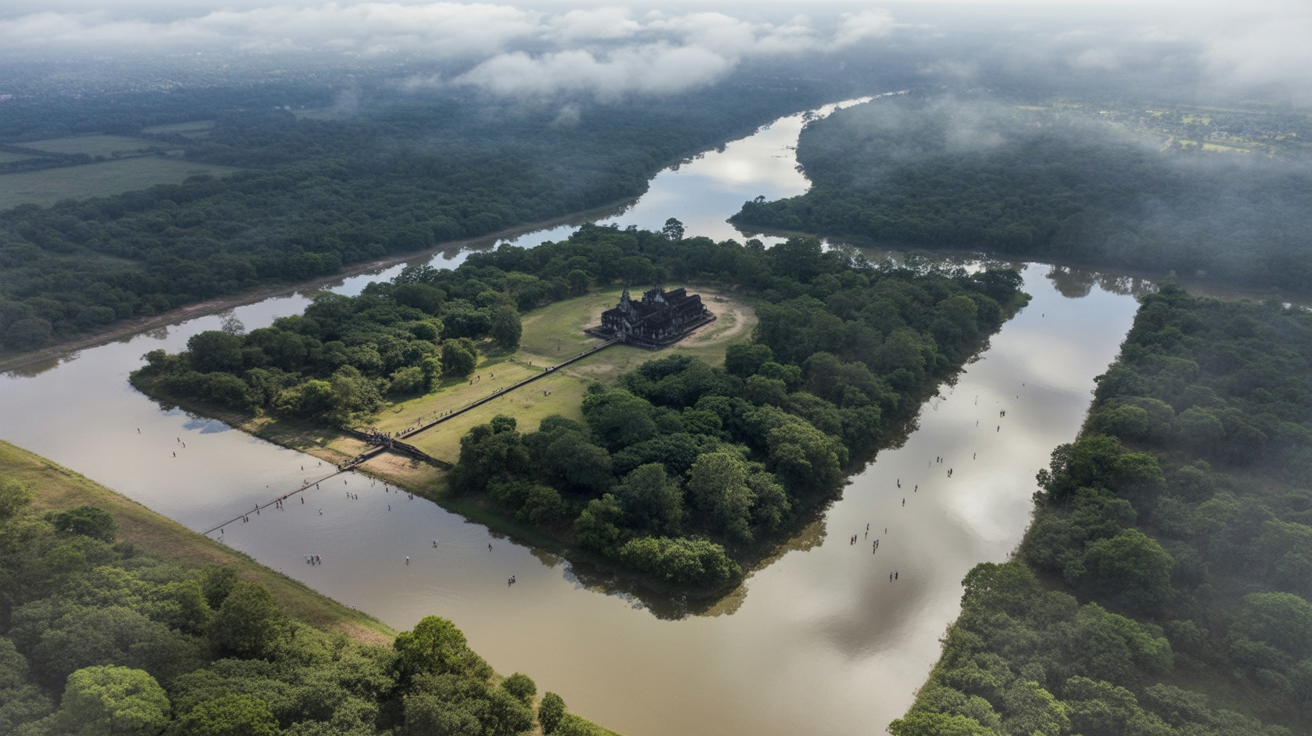
The core complex (short circuit zone): Angkor Wat, Angkor Thom (which includes several temples — Bayon, Baphuon, the Terrace of the Elephants, the Terrace of the Leper King), and Ta Prohm. These are the three everyone comes to see and the foundation of any Angkor visit.
The extended circuit (long circuit zone): Pre Rup, East Mebon, Banteay Kdei, Sras Srang reservoir, Ta Som, Neak Pean. Less visited, less crowded, and essential context for understanding what the core temples are sitting inside.
Outlying temples (separate tickets or long drives): Banteay Srei (35km northeast, famous for intricate pink sandstone carvings), Phnom Kulen National Park (separate ticket, not covered by the Angkor Pass), Beng Mealea (70km east, jungle-consumed ruins, no roof).
The ticket office is located 4km north of Siem Reap town on the road toward the temples — you must pass through it to enter the park. GPS: 13.4300° N, 103.8600° E.
The Angkor Pass: Which Ticket to Buy
Three options. The decision is based on how many days you have, not how many temples you want to see.
1-day pass: Fine if you genuinely only have one day. You’ll see Angkor Wat, the Bayon, and Ta Prohm at a sprint. The sprint is noticeable.
3-day pass: The correct choice for most visitors. Gives you a full day for the short circuit, a full day for the long circuit, and a third day for Banteay Srei and whatever you want to revisit. The 10-day window means you can leave one day free for rest or exploring Siem Reap.
7-day pass: Worth it if you’re spending a week in Siem Reap or want to include outlying temples. At $72 for seven days, it’s the best value per day by a significant margin.
ℹKnow Before You Go
The ticket office opens at 4:30am specifically for sunrise visitors. A ticket bought after 5pm on one day is valid from 5am the following day — so if you’re arriving in the evening, buy your pass at the ticket office on the way in from the airport and it counts as day one starting the next morning.
Getting from Siem Reap to Angkor
Siem Reap town is 6–8km from Angkor Wat itself. Three practical options.
Tuk-tuk: The standard. A tuk-tuk driver hired for a full day at the temples costs $15–20 (~£12–16) depending on which circuit you’re doing and how far you negotiate. The driver waits at each temple while you visit and takes you to the next one. For the short circuit, budget $15. For the long circuit or Banteay Srei, $20–25. Negotiate the price and the itinerary before you leave Siem Reap. Ask your guesthouse to recommend a driver they know — this is how I found mine, and I’ve used the same person for every subsequent visit.
Bicycle: About $5/day for a basic bicycle. The short circuit (17km) is very doable on a flat road with occasional gentle hills. The long circuit (26km) is manageable in cool season but demanding in April–May heat. Not suitable for Banteay Srei (35km). Cycling gives you complete flexibility on stopping and has a specific quality to it — arriving at Ta Prohm by bicycle at 7:30am before the crowds is a different experience from arriving by tuk-tuk at 9am.
Car with driver: $25–35 per day. Useful for families with young children, for visiting multiple outlying temples in one day, or for anyone who wants air conditioning between temples in peak heat.
The Short Circuit: The Essential Angkor (~17km)
The short circuit connects the three temples that every visit to Angkor must include. In order of recommended visit:
Angkor Wat
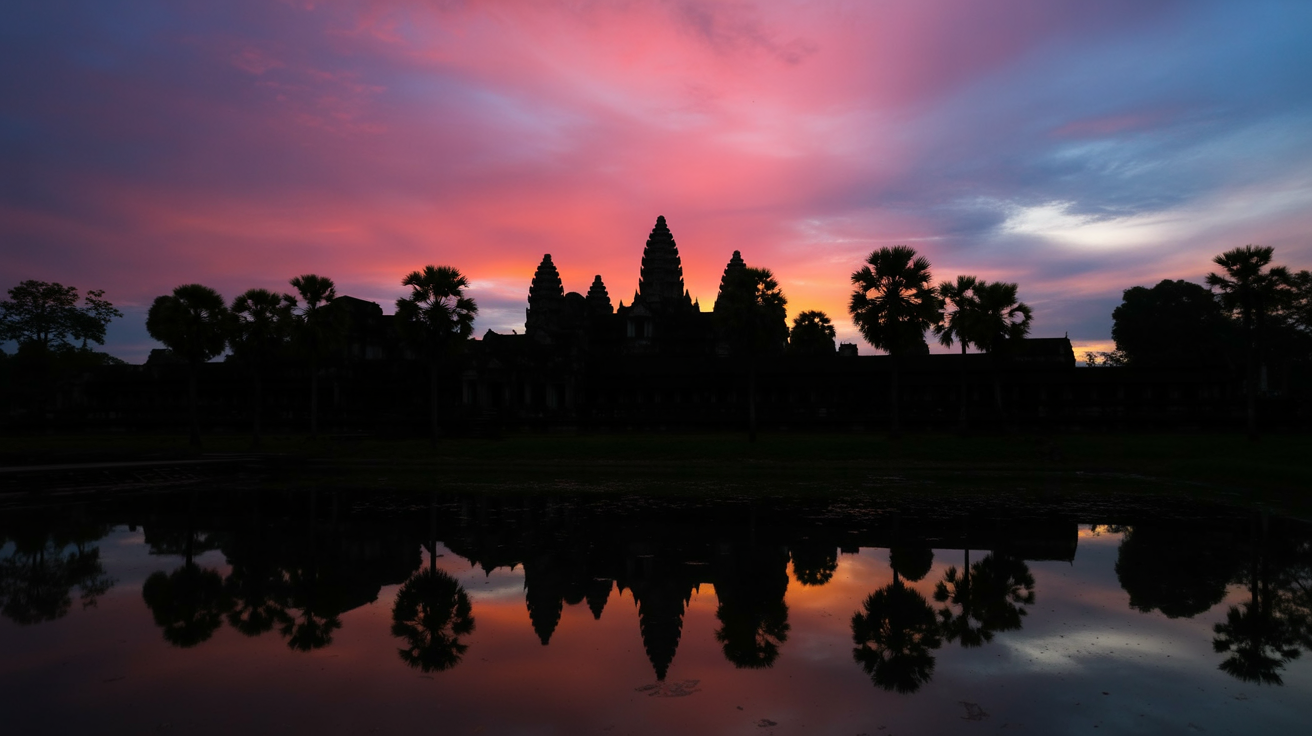
The largest religious monument ever built. 12th century, Khmer Empire, dedicated to Vishnu. The stone is warm by 7am and the jungle hasn’t finished taking it back in the parts that haven’t been restored. That sentence explains why the photographs don’t capture it.
GPS: 13.4125° N, 103.8670° E.
For sunrise: arrive at the main entrance before 5:15am. The reflection pool position — just inside the main gate, to the right of the main causeway, a small pond that reflects the five towers at dawn — fills up by 5:30am on busy days. October to March is the reliable dry-season window for clear sunrise light. April to May: sun rises, but haze from heat can soften the light. June to October: cloud cover is variable, and the rain season can make sunrise unpredictable but the landscape greener.
Allow at least 2 hours inside. More if you want to climb to the upper level (requires covered shoulders and knees; there is a scarf lending service at the base). The inner galleries have bas-reliefs that run 800 metres — this alone is an hour at reading pace. Most people do it at a trot and miss most of what’s there.
For the full ticket and timing breakdown: Angkor Wat Tickets: What Nobody Tells First-Timers.
Angkor Thom and the Bayon
Angkor Thom (the “Great City”) is a 9 square kilometre walled complex north of Angkor Wat — a separate fortified city, not just a temple. Enter through the South Gate on the main road: the 23-metre gate towers are covered in carved faces that look out in four directions, identical to the faces on the Bayon’s towers inside.
The Bayon is the centrepiece — a 12th-century state temple at the exact centre of Angkor Thom, covered in 216 enormous stone faces. GPS: 13.4416° N, 103.8587° E. Allow 1–1.5 hours inside. The faces are at their best in late afternoon light when the stone turns golden. If you’re doing sunrise at Angkor Wat and then the short circuit, save the Bayon for late afternoon on day two.
Also inside Angkor Thom: the Baphuon (11th century, under lengthy restoration, partially accessible), the Terrace of the Elephants (a 350-metre processional terrace covered in elephant carvings), and the Terrace of the Leper King (a smaller terrace with intricate undercroft carvings that most visitors walk past).
Ta Prohm
The temple the jungle is eating. Enormous strangler fig and silk-cotton tree roots have grown through and over the stone structures since the 12th century — the Tomb Raider temple, the one in every jungle-photography compilation, the one that makes it clear why restoring Angkor entirely would be the wrong decision.
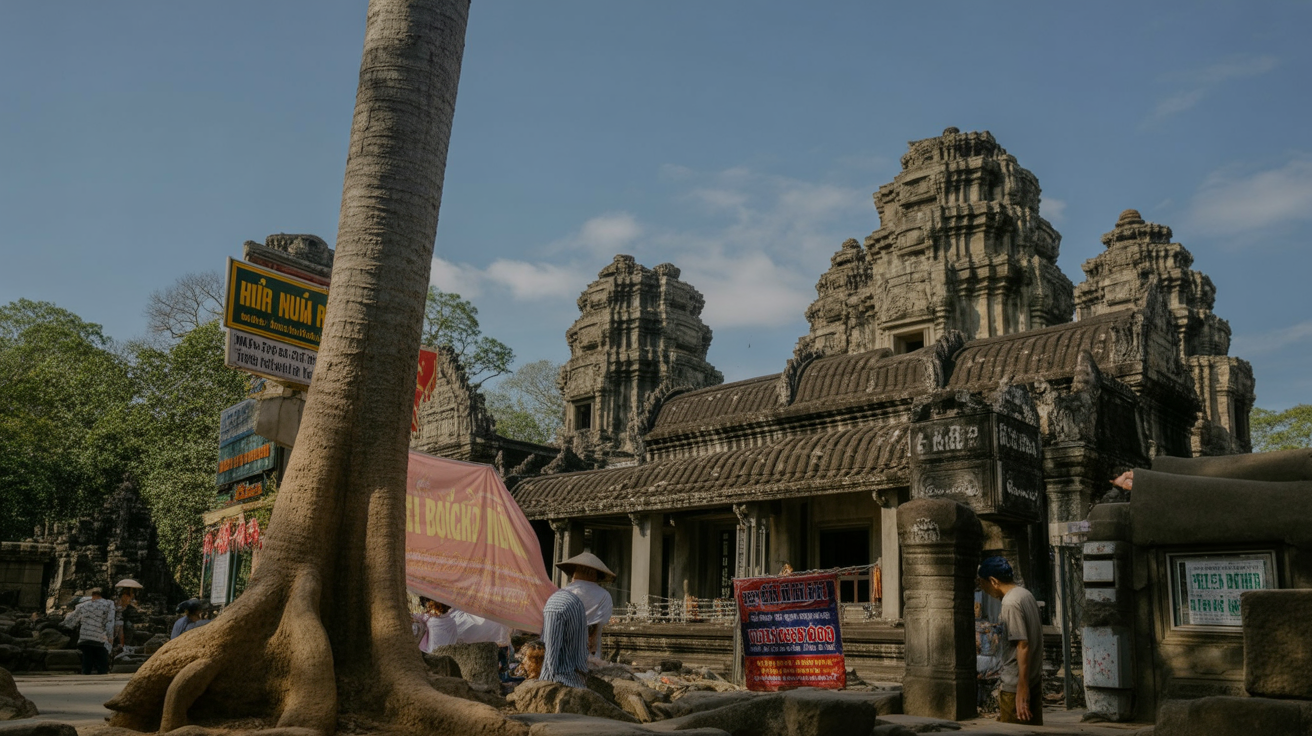
GPS: 13.4349° N, 103.8893° E. Allow 1–1.5 hours. Go early in the morning — by 10am it has the highest crowd density in the park. The specific root formations that appear in photographs have queues for photography spots by mid-morning. 7:30am is the right time to be here.
The Long Circuit: Beyond the Essentials (~26km)
The long circuit adds the outer temples — less visited, with a different character from the core three. Worth a dedicated second day.
Pre Rup (10th century): a state temple with a tower sanctuary on a tiered platform. Quieter than any of the short circuit temples. The view from the top level at late afternoon is one of the better Angkor sunsets. Crowd level: low.
East Mebon (10th century, same architect as Pre Rup): sits in what was the centre of a large reservoir that no longer holds water. Good for context on how the Angkor hydraulic system worked — the surrounding landscape was engineered as much as the temples.
Banteay Kdei (12th–13th century): a Buddhist monastery complex adjacent to the Sras Srang reservoir. Less restored than the main temples, which makes it more atmospheric. The reservoir at dawn — with the mist off the water and the temple reflection — is worth the detour.
Outlying Temples: Banteay Srei and Beyond
Banteay Srei (35km northeast): a 10th-century temple carved in pink sandstone at a scale and detail that seems impossible given the tools available at the time. The carvings are intact in a way that the larger temples aren’t, and the scale is intimate rather than overwhelming. Worth a half-day, best combined with lunch at a restaurant in the nearby village. Requires separate transport — tuk-tuk from Siem Reap, $20–25 return including waiting time.
Beng Mealea (70km east): a 12th-century temple that has been left almost entirely to the jungle — no restoration, just wooden walkways through the collapsed stone. If Ta Prohm is Angkor showing you the jungle’s work, Beng Mealea is the jungle’s finished product. 2.5-hour round trip by tuk-tuk; worth it if you have a spare day and the right driver.
What to Wear and Bring: The Practical Checklist
Angkor is an active religious site — several temples are still used for Buddhist worship — and the dress code reflects this. Getting it wrong costs you entry to specific areas and occasionally to entire temples.
Dress code: Shoulders and knees covered at all major temples. At Angkor Wat specifically, this is enforced at the inner sanctuary (the stairs to the upper level) where scarf rentals are available at the base. At most other temples, the general rule applies but enforcement is more relaxed for the outer areas. Safe minimum: long trousers or a long skirt, a t-shirt with shoulders covered. A lightweight linen shirt covers the rules while being bearable in 35°C heat. Do not rely on getting a sarong at the gate — bring your own or plan to stay out of restricted areas.
Water: Carry 2 litres minimum per person per day. You will drink more than you expect. Water vendors operate throughout the park but the furthest-out temples on the long circuit can have a gap of 30+ minutes between vendors. Freeze a bottle overnight and put it in your bag — it will be cold water for the first three hours.
Shoes: Wear the most comfortable footwear you own that covers the upper foot (sandals with straps, not flip-flops). Many temple areas involve uneven stone surfaces, steep steps without handrails, and rubble sections around the less-restored sites. Flat, closed footwear is the standard recommendation. Heels are wrong. Bare feet are wrong for the temple interiors.
Sun protection: Hat, sunscreen, and a lightweight covering layer. The stone of the temples reflects heat; midday from 11am to 2pm is genuinely brutal. Plan your temple visits to avoid standing in open courtyards during these hours — or plan to be inside the shaded gallery sections. The Bayon’s inner galleries and Angkor Wat’s outer corridor offer good midday shade.
Camera batteries: Charge them the night before. A full day at Angkor generates a significant number of photographs. Portable battery packs are widely available in Siem Reap’s night market for $10–15 if you don’t have one.
Cash: USD is accepted everywhere at Angkor for entry fees, food, and transport. Most vendors and tuk-tuk drivers don’t carry change for large bills — bring $1 and $5 notes. The ticket office takes card but many of the individual temple food stalls are cash only. Budget $15–25 per person per day for food and drinks within the park.
Download offline maps: Maps.me with the Cambodia offline pack covers the temple roads in the park with more detail than Google Maps. Download it in Siem Reap before entering — mobile data coverage can be spotty in the outer circuits. Knowing which junction leads to Pre Rup versus East Mebon saves genuine confusion when the sign at the junction is in Khmer only.
For the full Cambodia safety and practical information: Is Cambodia Safe? covers transport safety, scams, and what to watch for at tourist sites.
The Confession: My First Navigation Error
On my first visit I decided to cycle the short circuit alone. Good idea in principle. I left Ta Prohm heading for the Bayon, followed what I thought was the circuit road north, and cycled for 25 minutes before realising I was heading east rather than northwest, toward a smaller temple I didn’t recognise and hadn’t planned to visit.
The temple turned out to be Banteay Kdei, which is on the long circuit and is genuinely excellent and which I hadn’t intended to visit that day. I spent an hour there by accident. It was one of the better hours of the trip.
This is not a cautionary tale. It’s an observation that getting slightly lost in Angkor occasionally produces better outcomes than staying strictly on route. But download the Maps.me offline map before you leave Siem Reap, because the roads inside the park have minimal signage and “generally north” is not enough to navigate by.
FAQ: Siem Reap and Angkor Wat Map
- What is the difference between Angkor Wat and Angkor Thom?
- Angkor Wat is a single temple — the largest, most famous, and most visited in the park. Angkor Thom is a walled city containing several temples, including the Bayon (with its famous face towers). They’re separate sites about 2km apart, both covered by the Angkor Pass, and both essential to a proper Angkor visit. Most people spend 2 hours at Angkor Wat and 1.5 hours at Angkor Thom/Bayon.
- How many days do you need at Angkor?
- Two full days minimum for the core temples (short circuit day one, long circuit day two). Three days if you want to add Banteay Srei or outlying temples. One day is possible but rushed — you’ll see the main three at pace without understanding what you’re walking through. The 3-day Angkor Pass ($62) is the right call for most visitors.
- What time should I arrive at Angkor Wat for sunrise?
- Before 5:15am to get the reflection pool position — a small pond to the right of the main causeway just inside the main gate that reflects the five towers. The ticket office opens at 4:30am. By 5:30am on a busy day the reflection pool has a crowd. October to March is the most reliable for clear sunrise light. Tuk-tuk from Siem Reap at 4:45am gets you there in time.
- What is the short circuit at Angkor?
- The short circuit is approximately 17km and covers the core temples: Angkor Wat, Angkor Thom (including the Bayon), and Ta Prohm. It’s the essential one-day Angkor itinerary. Add the South Gate of Angkor Thom as a stop — the face towers on the gate are as impressive as anything inside the complex. A tuk-tuk for the short circuit runs $15.
- Is Banteay Srei worth visiting?
- Yes — if you have a third day or a spare half-day. The pink sandstone carvings at Banteay Srei are more detailed and better-preserved than anything in the main Angkor complex, and the scale is intimate rather than overwhelming. It’s 35km from Siem Reap and not on the main circuit, so it requires separate transport (tuk-tuk, $20–25 return). Combine it with a morning visit to keep the afternoon for rest or the night market.
- How do I get around Angkor Wat independently?
- Tuk-tuk with a driver ($15–20/day, negotiate in Siem Reap) is the most practical option — the driver waits between temples and handles the navigation. Bicycle ($5/day) is a good option for the short circuit if you’re comfortable with 17km in the heat. Download Maps.me with the offline Cambodia map before you enter the park — signage inside is minimal and some of the circuit roads look identical.
Siem Reap Town: How It’s Laid Out
Most visitors to Siem Reap concentrate on Angkor and treat the town itself as logistics. That’s a reasonable choice, but understanding how the town is laid out helps with accommodation decisions, restaurant access, and working out why your guesthouse and the temple complex are further apart than the map suggested.
Siem Reap town sits roughly 6–8km south of the main Angkor Wat entrance. The route between them is Road 60, which passes through the Angkor Enterprise ticket office — so every Angkor visit begins by passing through the town’s northern suburbs.
The Old Market area (Psar Chas): The tourist and commercial hub. The covered market is at the centre, with the Siem Reap River on the east side and Pub Street half a block to the west. Most budget guesthouses, restaurants, and tour operators are within 300 metres of the Old Market. The streets immediately surrounding it are walkable and the concentration of food options is highest here.
Pub Street and the tourist corridor: Running northwest from the Old Market, Pub Street (officially Street 8) is the neon strip — backpacker bars, tourist restaurants, tuk-tuk ranks. It connects to the Alley (a parallel street with the same function) and feeds into the night market zone on Sivutha Boulevard. This whole corridor is 500 metres end to end. It sounds bigger in travel writing than it is.
The Wat Bo area (east of the river): Quieter than the Old Market side, with a cluster of mid-range guesthouses and the Wat Bo temple at the south end. The walk from here to the Old Market takes 15 minutes. Preferred by visitors who want to be near the action but not in it.
The French Quarter and NR6: The stretch of National Road 6 east of the town centre has some of the larger international hotels (Victoria Angkor, FCC Angkor is actually here, not on the river). Convenient for the airport (12km east on NR6) and for the road to Phnom Penh, but further from the temple circuit than the Old Market area.
Getting between town and temples: The standard tuk-tuk from the Old Market area to the Angkor Wat entrance is 20–25 minutes, $3–5 for the ride on the Grab app or $5–8 negotiated. Bicycles from the Old Market area to Angkor Wat: 35–45 minutes on flat roads. Tuk-tuks available 24 hours including 5am sunrise runs — your guesthouse can arrange this the night before or you can use Grab.
Useful landmarks on the map:
- Angkor Enterprise ticket office: GPS 13.4300°N, 103.8600°E — on Road 60, 4km north of Old Market
- Angkor Wat main entrance: GPS 13.4125°N, 103.8670°E — 6km from Old Market
- Old Market (Psar Chas): GPS 13.3542°N, 103.8564°E
- Phare Circus: GPS 13.3699°N, 103.8508°E — on NR5 north of the Old Market
- Siem Reap International Airport: GPS 13.4110°N, 103.8127°E — 7km northwest of town
Planning Your Angkor Days
Day one: sunrise at Angkor Wat (5am start), then the inner gallery and upper level (until 9am before crowds). Move to Ta Prohm by 9:30am (early enough to avoid the worst queue for the photograph spots). Angkor Thom and Bayon in late afternoon for the golden light on the faces.
Day two: long circuit in the morning — Pre Rup at dawn (quieter than anything on the short circuit), East Mebon, Banteay Kdei and Sras Srang reservoir. Afternoon for the Baphuon and Terrace of the Elephants inside Angkor Thom that you skimmed on day one.
Day three: Banteay Srei in the morning (hire a car for this — tuk-tuk is fine but 35km adds up). Afternoon for whatever you missed or want to revisit.
For the full Siem Reap context — what to do when you’re not at the temples, where to eat, where to stay: Things to Do in Siem Reap.