Angkor Wat Sunrise: The Honest Guide to the Reflecting Pools, the Crowds, and What Actually Works
Updated June 2026 — James Hartley has been living in Phnom Penh for four years and has watched Angkor Wat sunrise more times than he can honestly justify. Including twice in one week when a mate from Manchester visited and then his sister visited three days later. Prices verified June 2026.
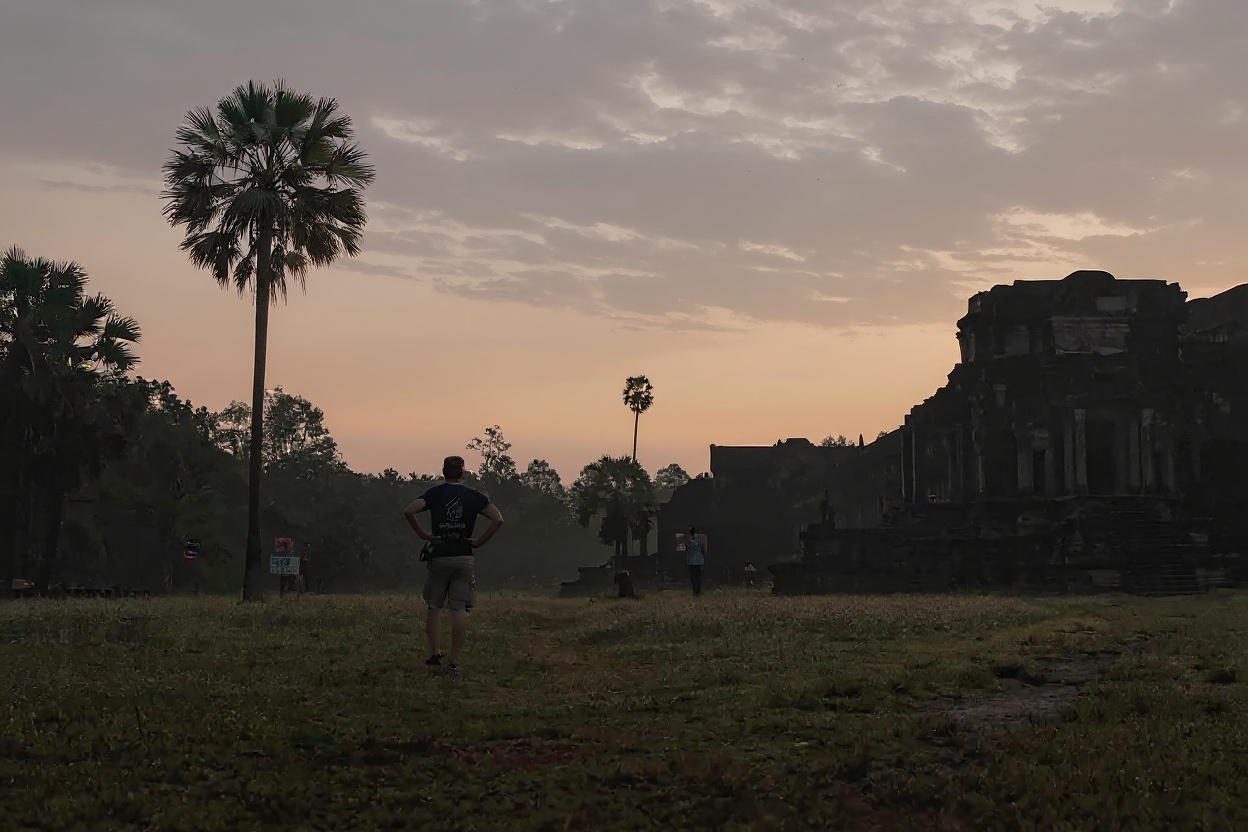
The Angkor Wat sunrise is real, it’s worth it, and you will be sharing it with several hundred other people. That doesn’t cancel the experience — it just means you need to arrive earlier than you think, stand in the right spot, and understand that the photograph you’re trying to take is one of the most attempted photographs in Southeast Asia. This guide tells you how to make it work.
Why the Sunrise Works the Way It Does
Angkor Wat faces west — unusual for a Hindu and later Buddhist temple, and something most visitors don’t clock until they’re standing at the reflecting pools and wondering why the sunrise is behind the main towers rather than in front of them.
That’s the whole point. The sun rises in the east, behind the temple. The towers are silhouetted against the brightening sky. If you’re standing at the western causeway — the main entrance — you’re looking east at the silhouettes with the reflecting pools in front of you. When the light turns orange and pink behind the towers, the pools catch the reflection perfectly, and you get the shot that’s on approximately 40% of Cambodia travel blogs.
The light is best for about 40 minutes, from roughly 15 minutes before the actual sunrise to 20 minutes after. The pool reflection is clearest when there’s no wind and no other people in the water. Both conditions hold until about 6am. After that: wind picks up, people wade in for photos, and the magic turns into logistics.
The Reflecting Pools: Where to Stand
There are two rectangular reflecting pools flanking the main causeway — one to the north of the path, one to the south. The south pool is marginally more popular because the angle to the main towers is slightly cleaner. Both work. Pick one and commit to it rather than walking between them when the light starts changing.
The best position is at the near edge of the pool (the end closest to the western entrance) rather than the far end. From the near edge, the towers fill more of the frame and the reflection is more complete. From the far end, you get more context but smaller towers.
To get a front-row position at the south pool, you need to be there by 5:00am. The park opens at 5:00am. People queue at the gate before that. In high season (November-February), people arrive at 4:30am and wait at the gate. This is not a drill — if you arrive at 5:30am expecting a clear spot at the pools, you’ll be standing three rows back taking photos of other people taking photos.
REAL TALK: The first time I went to the Angkor Wat sunrise, I arrived at 5:30am thinking that was early. There were already 200 people at the reflecting pools. I spent 45 minutes at the back, photographed the backs of heads, and came away with exactly zero usable shots. Second time: arrived at 4:55am, waited at the gate, walked straight to the south pool, got front position. Same sunrise. Completely different experience. Arrive before 5am. Non-negotiable.
Alternative Spots: When the Main Pools Are Too Crowded
If you’ve arrived and the reflecting pools are already five-deep with photographers, you have options.
Library 2 (the southern library) — the small stone library building to the south of the main causeway has a raised platform that gives you a slightly elevated view of the towers from an angle. Fewer people know about it, so the crowd is lighter. The reflection angle is different from the pools — you’re shooting from the side rather than straight on — but the composition can be more interesting. Get there fast if the pools are full.
The northwest corner tower — walk around to the northwest corner of the outer wall. The towers align differently from here and you get the morning light catching the stone at a low angle. Almost nobody is here at sunrise. The shot is less iconic but it’s yours alone.
The upper gallery level — if you’re inside the temple itself, the upper gallery (accessed via steep stairs — vertiginous, use the handrails) looks back west over the causeway and the pools with the sky behind you. At sunrise the light comes in from the east and illuminates the gallery stonework in a way that no photograph really captures. Worth going up even if the exterior shot isn’t happening.
| Angkor Wat Sunrise Essentials (2026) | |
|---|---|
| Park opening time | 5:00am — queue at the gate from 4:30–4:45am in peak season |
| Best arrival at reflecting pools | By 5:00am — earlier in Nov–Feb peak season |
| Sunrise time (approx) | 5:45am (Dec/Jan) — 6:15am (May/Jun) — check timeanddate.com for exact date |
| Best light window | 15 min before sunrise to 20 min after |
| Angkor pass (1-day) | $37 — must be bought day before, park ticket office closes 5pm |
| Angkor pass (3-day) | $62 — most practical for a proper Angkor visit |
| Tuk-tuk from Siem Reap | $12–15 return — negotiate the evening before, leave by 4:45am |
| Dress code | Shoulders AND knees covered — enforced at the gate, no exceptions |
| Best months | November–February (clear skies, cool mornings). Avoid April–May (hazy) |
Sorting Your Angkor Pass Before Sunrise
This is the logistical piece that catches people out. The Angkor Archaeological Park ticket office opens at 5:00am but closes at 5:00pm the day before for advance ticket sales. If you plan a sunrise visit, you need your pass before you go to bed that night.
Buy your pass at the ticket centre on the road to Angkor (Airport Road area, 4km from Siem Reap town). Opening hours: 5:00am–5:30pm daily. Photo is taken at the desk. The three-day pass ($62) is the most practical if you’re spending proper time at Angkor — the temples across the whole complex take at least two full days to cover well. The seven-day pass ($72) is the best value if you have any flexibility in your schedule.
The one-day pass ($37) is fine for a single morning. But given that the temples are extraordinary and you’re already in Siem Reap, the three-day option makes more sense for anyone who cares about history or archaeology. Our Angkor Wat tickets guide has the full breakdown on pass types and what’s included.
Airport ticket booth: if you’re flying into Siem Reap Airport in the afternoon or evening before your sunrise visit, there’s a ticket booth in the arrivals hall. Buy it there. Saves the separate detour.
Getting to Angkor Wat for Sunrise
Angkor Wat is 7km from Siem Reap town centre. The standard transport is a tuk-tuk (the motorised rickshaw that’s the default vehicle for Angkor visits). A return trip — including waiting for you during the sunrise and bringing you back after your morning temple visit — costs $12–15.
Arrange this the evening before with your hotel or guesthouse, or directly with a tuk-tuk driver you’ve used during your stay. The drivers who do the sunrise run are experienced with the timing and will get you to the gate by 4:45–4:50am. Tell them you want to be at the gate before it opens. Any experienced sunrise driver knows what this means.
Departure time from Siem Reap: 4:30–4:45am depending on where you’re staying and traffic. It’s still dark. It’s genuinely fine — the road to Angkor is well-surfaced and the tuk-tuk handles it easily.
Bicycle: some people cycle the 7km from Siem Reap. Rental bikes are $3–5/day from guesthouses. The road is flat and lit by streetlamps for most of the route. It adds about 25 minutes each way. Fine if you’re comfortable cycling in the dark on a Cambodian road. Not recommended if you’re not.
JAMES’S PICK: Find a tuk-tuk driver on day one of your Siem Reap visit and arrange the full Angkor circuit with them for your stay — sunrise run, full-day temple circuit, transfers. Agree the price upfront. $20–25/day for a driver who knows the temples is fair and builds a relationship that’s worth more than the couple of dollars you’d save bargaining with a stranger at 4:45am. My driver Sokha had my coffee order memorised by day two.
What to Photograph and When
The sunrise sequence has three distinct phases, each with different photographic opportunities.
Pre-sunrise (5:00–5:30am): the sky lightens from grey-blue to pale pink behind the towers. The pool reflection is its clearest — still water, towers in silhouette, the horizontal bands of colour above the treeline. This is the shot most people miss by arriving too late. The towers aren’t dramatically lit yet but the reflection and the colour gradation are extraordinary.
Sunrise moment (5:45–6:15am depending on date): the sun clears the horizon east of the temple. The towers go from silhouette to partially lit — the eastern faces catching gold, the western faces (facing you) still in shadow. This is the most dramatic 10 minutes and the hardest to photograph because the dynamic range is enormous. Your phone will struggle. A camera with manual controls handles it better.
Post-sunrise (6:15–7:30am): the light normalises and the temple itself becomes the subject rather than the sky. Walk the outer gallery. Go up the steep stairs to the upper level if you haven’t already. The stone turns golden-warm and the carved bas-reliefs along the gallery walls become properly visible. The tour groups are starting to arrive but haven’t overwhelmed the site yet. This is the hour to actually look at what you came to see.
After Sunrise: The Temple Before the Crowds
The Angkor Wat sunrise gets all the attention and then everyone leaves for breakfast by 7:30am. This is the mistake. The temple in the hour after the sunrise crowd disperses — roughly 7:00–9:00am — is the best time to actually see it.
The outer gallery runs for 800 metres along the inner walls and contains the longest continuous carved bas-relief in the world — scenes from Hindu mythology, historical battles of the Khmer empire, the Churning of the Ocean of Milk on the east gallery. At 7:30am, the light enters the gallery horizontally and the carved panels catch it at an angle that makes the figures leap off the stone. By 10am, the light is overhead and flat and the gallery is full of tour groups.
The central sanctuary — the main tower at the centre of the temple — requires a modest dress code (both shoulders and knees covered) and some steep stairs. The view from the upper terrace looks out over the full temple complex and back toward the causeway where you were standing for the sunrise. It puts the scale of the thing in context.
Budget a minimum of 2 hours inside the temple after the sunrise. If this is your one day at Angkor, a tuk-tuk tour of the surrounding temples (Ta Prohm, Bayon, Baphuon) fills the rest of the morning before the midday heat makes everything miserable. The Angkor Wat tours guide covers the options and prices for guided circuits.
What to Wear and Bring
Dress code: shoulders AND knees must be covered to enter the temple complex. This is enforced. Sarongs are available to borrow at the entrance but they’re thin, they’re not always clean, and they’re attached to dozens of other people’s mornings. Wear what works from the start — lightweight long trousers or a loose skirt, a light long-sleeved shirt or a shawl you can throw on.
At 5am in Siem Reap, the temperature is typically 22–26°C — cool enough that you’ll be comfortable in a light layer, warm enough that anything heavier will be off within an hour.
Bring: water (the temple complex has drinks vendors but they’re marked up significantly at the entrance), a small torch for the pre-dawn walk from the gate to the pools, insect repellent (the pool area can have mosquitoes in the early morning), and your Angkor pass on your person rather than in your bag.
Best Time of Year for Angkor Wat Sunrise
November–February is the prime window. The sky is clear, the humidity is lower, and the pre-dawn air has an actual coolness to it — 20–23°C rather than the oppressive warmth of the wet season. The downside: this is peak tourist season and the reflecting pools are at their most crowded. Arrive earlier than you think you need to.
March–May is drier but increasingly hazy — agricultural burning in the region and the building heat both reduce visibility. The sunrises happen earlier and the colours can be muted. Not the ideal window for the photograph, though the temples are less crowded.
June–October is rainy season. The sunrise can be blocked by cloud — some mornings are completely overcast, some have dramatic cloud formations that create extraordinary light. The temple complex is significantly less crowded and the surrounding moat and vegetation are at their greenest. Worth considering if you’re flexible and willing to accept a 50/50 outcome on the sunrise itself.
For the complete seasonal picture across Cambodia — the best months for Kampot, Koh Rong, and the coast — the best time to visit Cambodia guide covers the full breakdown by region.
Sunrise Tour vs. DIY
Tour operators in Siem Reap offer sunrise packages — tuk-tuk transfer, guide, sometimes breakfast — for $20–40 per person. They work fine and the guide adds context to the temple visit. The downside: you’re on a group timeline, the guide’s photography spot preference may not align with yours, and you’re sharing the tuk-tuk with strangers whose alarm clock reliability is not your problem.
DIY is straightforward. Arrange your tuk-tuk driver the night before, buy your pass in the afternoon, set your alarm for 4:15am, go. You control the timing, the spot, and when you leave. The only advantage of a tour is if you want a guide for the temple history — which is genuinely valuable context, but can also be arranged separately as a morning guide service at the temple entrance ($15–25).
The things to do in Siem Reap guide covers how to structure the wider Siem Reap trip around the Angkor complex, including the outlying temples and what’s worth your time beyond the main circuit.
What Happens If the Sky Is Cloudy
It happens. You set the alarm for 4:15am, you wait in the dark at the reflecting pool, and the sun rises into a white wall of cloud. No colours, no reflection, no dramatic silhouette. Just grey light and several hundred disappointed photographers.
Here’s what you do: go into the temple. A cloudy morning is genuinely better for exploring the interior — the harsh shadows that come with a sunny morning disappear, the carved gallery panels are evenly lit, and the stone takes on a silver-grey colour that’s actually more photogenic than the midday yellow. Some of the best Angkor photos I’ve taken have been on overcast mornings when the “sunrise” was a non-event.
If you have a multi-day pass, you go back. Simple as that. Check the weather the night before, but accept that Cambodian weather in the transition seasons doesn’t care about your plans. The temple is there every morning. You adjust.
- What time should I arrive at Angkor Wat for sunrise?
- Be at the gate when it opens at 5:00am. In high season (November–February), aim for 4:45am to queue before opening. The reflecting pools fill up fast. If you arrive at 5:30am expecting a front position, you’ll be three rows back. Earlier is always better.
- Do I need to buy my Angkor pass before the sunrise visit?
- Yes. The ticket office closes at 5:00–5:30pm the day before. Buy your pass that afternoon. The airport arrivals hall has a ticket booth if you’re arriving the evening before your sunrise visit. You cannot buy a pass at 5am — the pass counter at the park entrance only handles verification, not sales.
- Which reflecting pool is better for sunrise — north or south?
- The south pool gives a marginally cleaner angle to the main towers. The north pool is equally good and slightly less crowded because most guides direct groups to the south. In practice, both work — pick one and get a front position rather than splitting your attention between them.
- Is Angkor Wat sunrise worth it in rainy season?
- Worth attempting, but accept a 50/50 outcome on clear skies. Rainy season (June–October) means fewer crowds and significantly greener surroundings. If the sunrise is clouded over, the morning temple visit is genuinely better — flat light, no harsh shadows, and a fraction of the tourist numbers. Buy a 3-day pass and try again.
- Can I photograph Angkor Wat sunrise with a phone?
- Yes, with caveats. Modern smartphone cameras handle low light reasonably well but struggle with the dynamic range of a sunrise — very bright sky, very dark silhouetted towers. Use your phone’s pro or manual mode if available, expose for the sky rather than the towers, and accept that the photograph you take will be different from the processed ones you’ve seen online. The experience is better than any photograph of it.
- How long should I spend at Angkor Wat on the sunrise morning?
- Minimum 3 hours: 30–40 minutes at the reflecting pools, then 2+ hours inside the temple before the main tour groups arrive by 9am. If you’re on a 3-day or 7-day pass, stay as long as you like — the temple rewards multiple visits at different times of day. The bas-relief gallery alone takes 45 minutes if you’re reading the panels properly.
The Angkor Wat sunrise is not overrated. It’s one of the things that will make you stand still in the dark at 5am and feel, for a few minutes, that you are somewhere genuinely significant. The crowd doesn’t cancel that. It’s just a crowd. Get there before it forms. Stay after it disperses. Questions in the comments — I check most days.