Last updated: June 2026 — prices verified June 2026.
Cambodia is one of the cheapest countries in Southeast Asia to travel, and the budget guides that say you can do it on $20/day are technically correct if you eat local food exclusively, sleep in dorms, and don’t move around much. Most people spend more. The realistic backpacker number is $25–35/day. Mid-range independent travellers spend $55–80. The Angkor pass ($37–62) is a spike that throws off any daily average calculated without it. Here’s the actual breakdown.
I’ve been based in Phnom Penh for four years. I know what a plate of lok lak costs at a tourist restaurant versus at the place Sopheak from the noodle cart recommends. I’ve done the overland routes and paid the tuk-tuk negotiation tax. These numbers are current as of 2026.
The Quick Budget Tiers
Before the breakdown: the three broad tiers most travellers fall into.
Dorm beds ($5–10), local food only ($1–3/meal), minimal transport, slow travel between destinations, no tours. Achievable if you’re disciplined about it. The “£16/day” numbers you see in budget blogs are real — they just require eating exclusively from street stalls and not moving very fast.
Mix of dorms and cheap private rooms, some Western food, occasional tuk-tuk, a day trip or two. This is what most independent budget travellers actually spend once they’re on the ground and not optimising every decision.
Private rooms at guesthouses or budget hotels ($25–50/night), meals at proper sit-down restaurants, organised transport between cities, guided day trips. Comfortable travel without luxury.
Good hotels, private drivers, nicer restaurants, activities. Plenty of options at this level — Cambodia is very affordable for mid-market spending.
⚠Real Talk
The Angkor pass skews everything. If you spend $62 on a 3-day pass and divide it over three days, that’s $21/day before you’ve eaten breakfast. Budget blogs that quote “$25/day for Cambodia” often average Angkor costs over a whole trip or leave them out entirely. Factor Angkor in separately when you’re planning.
Accommodation Costs
Cambodia has a wide range at every price point.
Dorm beds: $5–12/night in Siem Reap and Phnom Penh. Quality varies considerably — some of the $5 dorms are fine, some are grim. Check recent reviews before booking anything under $8.
Budget private rooms: $15–25/night gets you a clean air-conditioned private room with en-suite bathroom in most cities. In Siem Reap, $20 is entirely reasonable for a guesthouse room near the Old Market.
Guesthouses and budget hotels: $25–45/night. Comfortable, fan or AC, usually includes breakfast. The sweet spot for mid-range independent travel.
Boutique and upmarket: $60–120/night in Siem Reap and Phnom Penh for genuinely good hotels with pools. Still considerably cheaper than equivalent quality in Bangkok or Singapore.
The islands (Koh Rong, Koh Rong Sanloem): bungalows run $15–35/night depending on proximity to the beach and whether you want electricity after 11pm (some don’t have it — check before booking if this matters to you).
Food Costs
Food in Cambodia is one of the genuine bargains of Southeast Asia, and the local food is actually excellent — so eating locally isn’t a sacrifice.
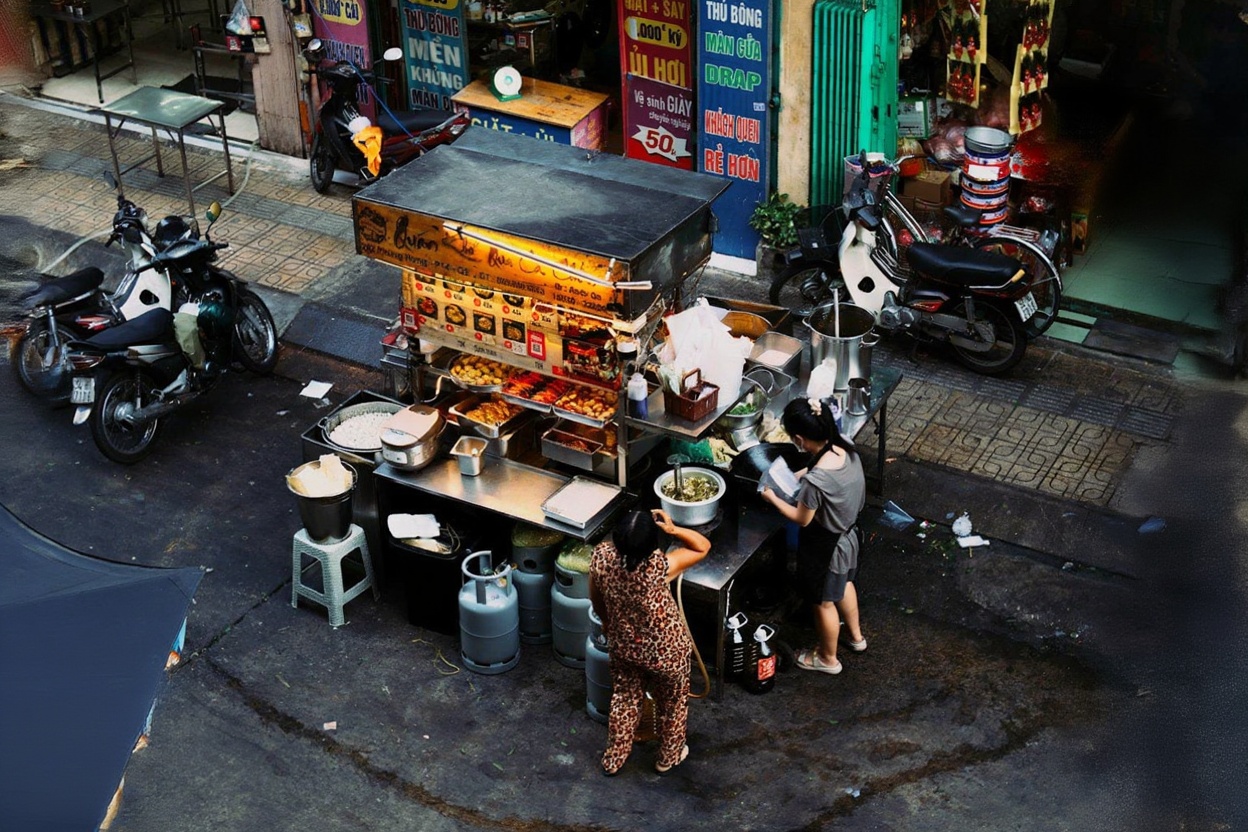
Street food and markets: $1–3 for a full plate. Noodle soup (kuy teav), rice with fish amok, lok lak with a fried egg, fresh fruit shakes — all in this range. The morning market stalls are the cheapest. $5/day for food is possible but requires commitment.
Local restaurants (Khmer-focused): $3–8 per person including a drink. The restaurants a block or two off the main tourist strips cost significantly less than those on them. A fish amok at a restaurant on Siem Reap’s Pub Street: $7–9. The same dish two streets away: $4–5.
Western food: $6–14 per main. The burger-and-pizza restaurants aimed at travellers charge roughly half what they’d cost in Bangkok. Still more expensive than local food — budget travellers who eat Western food exclusively will spend significantly more than those who don’t.
Beer: the famous Cambodia beer culture is real. Draft Angkor beer at happy hour: $0.50. Bottled beer at a bar: $1–1.50. A round of drinks for two people at a Phnom Penh rooftop bar: $6–10.
•JAMES’S PICK
For Phnom Penh: the restaurants on and around Street 308 in BKK1 offer a good mix of Khmer and international food at honest prices. For Siem Reap: the cluster of local restaurants on the east side of the Old Market — not the tourist-facing stalls on the street, the ones slightly inside. Prices drop immediately and the food is the same.
Transport Costs
This is where budget estimates most often go wrong. Transport between Cambodian cities adds up faster than the food savings.
Within cities — tuk-tuk:
– Short city trip: $1.50–3
– Tuk-tuk for the day (Angkor circuit): $20–25. The $13 figure in older guides is outdated — negotiate hard and you might get $15, but $20 is the realistic starting point in 2026.
– Grab app: transparent pricing, no negotiation. Good for fixed-price city trips.
Between cities — bus:
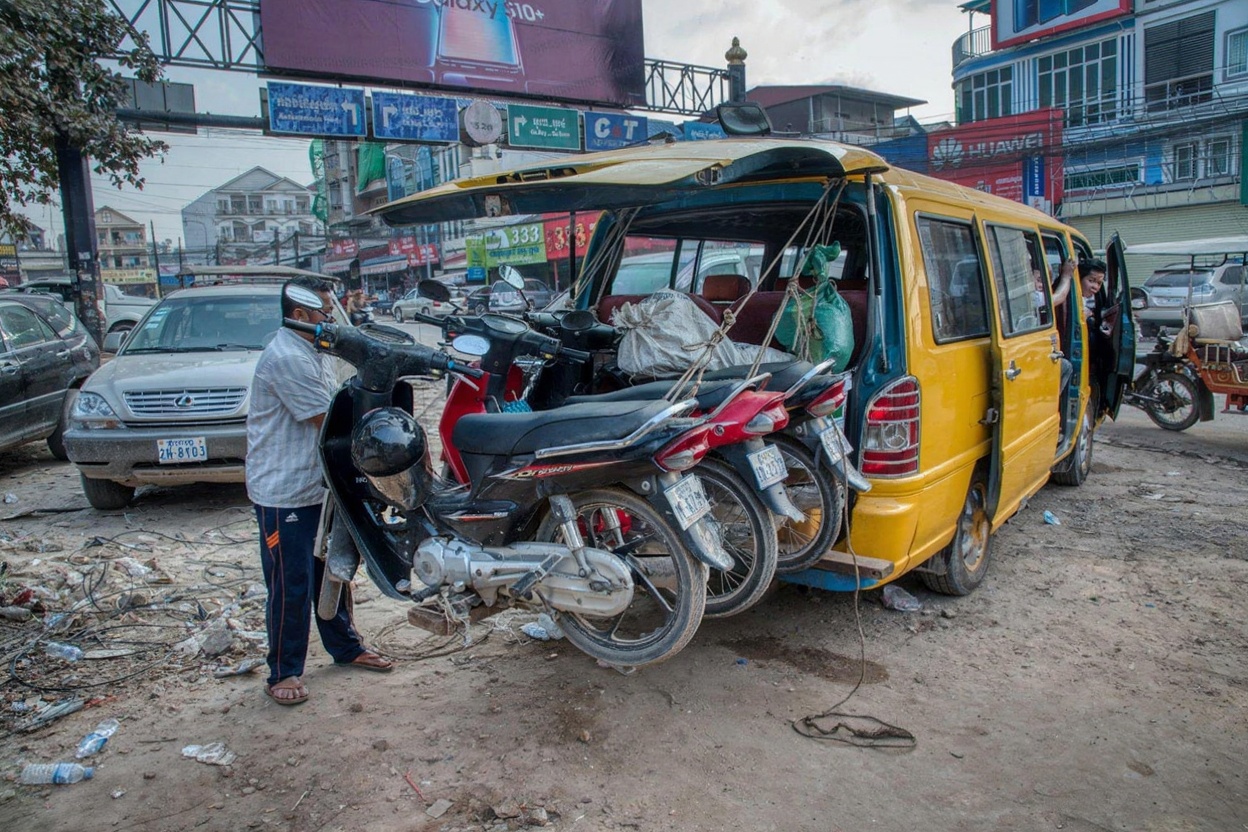
– Phnom Penh → Siem Reap: $8–12 (Giant Ibis or Mekong Express, 6 hours)
– Phnom Penh → Kampot: $7–10 (3–4 hours)
– Siem Reap → Battambang: $6–8 (3–4 hours)
– Phnom Penh → Sihanoukville: $8–12 (3–4 hours)
Arriving from neighbouring countries:
– Bangkok → Siem Reap (bus): ~$20
– Ho Chi Minh City → Phnom Penh (bus): ~$15–20
– Don Det, Laos → Siem Reap: ~$35–40
Ferries:
– Sihanoukville → Koh Rong: $12 each way
– Sihanoukville → Koh Rong Sanloem: $12 each way
– Kep → Rabbit Island (return): $7
Private car + driver: $40–60/day. Worth it for Angkor temple day trips with an experienced guide, or for getting between cities without the bus schedule. Some travellers hire a driver for a Phnom Penh → Siem Reap overland trip with stops — expect $80–100 for the full route with a guide.
Activities and Attractions
Angkor Archaeological Park:
– 1-day pass: $37
– 3-day pass: $62 (valid over any 7 days)
– 7-day pass: $72
The 3-day pass is worth it for most visitors — budget $62 and don’t try to cram it into one day.
Phnom Penh — the Killing Fields and Tuol Sleng:
– Choeng Ek Genocidal Center (Killing Fields): $6 entry, $3 audio guide (strongly recommended)
– Tuol Sleng (S-21) Genocide Museum: $5
Other activities:
– Phare Circus (Siem Reap): $18–38
– Akira Landmine Museum: $5–10 donation
– National Museum of Cambodia (Phnom Penh): $10
– Royal Palace (Phnom Penh): $10
– Cooking class with market visit: $25–35
– Kampong Khleang floating village boat: $8–12
Most other sightseeing in Cambodia — the temples around Phnom Penh, the Kampot riverfront, wandering markets — costs nothing.
Sample Daily Budgets
Dorm bed $8 · Breakfast (local market) $1.50 · Lunch (local restaurant) $3 · Dinner (local restaurant) $4 · Drinks (2 beers) $2 · Local transport (tuk-tuk) $4 · Snacks / water $1.50 · Miscellaneous $4
Private guesthouse room $28 · Breakfast (café) $4 · Lunch (mix of local and Western) $7 · Dinner (proper restaurant) $14 · Drinks (cocktails or beer at a bar) $8 · Transport (mix of Grab + tuk-tuk) $7
Boutique hotel $65 · Meals (restaurant quality throughout) $30 · Transport (private driver or Grab) $15 · Entrance fees / activities $10
Money Practicalities
Currency: Cambodia officially uses the Cambodian riel (KHR) but runs almost entirely on US dollars at tourist level. Prices are quoted in USD. You pay in USD. Change for amounts under $1 comes back in riel (roughly 4,100 KHR = $1). Don’t refuse riel change — just spend it on $0.50 items.
ATMs: widely available in Phnom Penh, Siem Reap, Sihanoukville, and Kampot. Fees: most ATMs charge $3–5 per withdrawal on top of whatever your bank charges. Use Charles Schwab (fee-free) or Wise if you’re doing this regularly. ACLEDA Bank and ABA Bank ATMs have lower fees than the tourist-area Canadia Bank machines.
Cards: accepted at hotels, most restaurants in tourist areas, and guesthouses. Not accepted at markets, local food stalls, tuk-tuks, or anywhere outside the tourist economy. Carry cash.
Withdrawals: take out larger amounts less frequently to minimise ATM fees. $200 at a time is sensible.
Exchange rate scam: some exchange offices and hotels offer a worse USD → KHR rate than the ATM equivalent. You rarely need to exchange into riel — USD is accepted everywhere that matters, and riel change comes naturally.
What Trips Actually Cost — Worked Examples
7 days: Phnom Penh + Siem Reap (backpacker)
– 2 nights Phnom Penh dorm: $20
– Bus to Siem Reap: $10
– 4 nights Siem Reap dorm: $36
– Angkor 3-day pass: $62
– Tuk-tuk Angkor: $22
– Food 7 days (@$10/day local): $70
– Killing Fields + Tuol Sleng: $14
– Misc transport: $15
– Total: ~$249 / ~$36/day
10 days: Phnom Penh + Siem Reap + Kampot (mid-range)
– 3 nights Phnom Penh private room: $75
– Bus + private room Kampot 3 nights: $85
– Bus Siem Reap + 4 nights private room: $120
– Angkor 3-day pass + tuk-tuk: $84
– Food 10 days (@$20/day): $200
– Activities and transport: $80
– Total: ~$644 / ~$64/day
Best Value Experiences in Cambodia
Some things in Cambodia punch well above their price point. Here’s where the money genuinely goes further.
The Killing Fields and Tuol Sleng combined ($14 total). These are not comfortable visits — but they’re among the most important things you can see in Southeast Asia. The Choeng Ek audio guide ($3, strongly recommended) was made with survivor testimony and is genuinely affecting. Tuol Sleng S-21 gives you the physical space of what was a school turned prison. Between them, $14 and half a day. The history makes the rest of Cambodia — the Buddhist temples, the village life, the countryside — make more sense.
Phare Circus in Siem Reap ($18–38). I’m normally sceptical of things that appear on every “Cambodia highlights” list. Phare is the exception. It’s a genuine circus school — Cambodian performers who trained from childhood — and the shows are technically excellent and narratively specific to Cambodian history. The $18 ticket gets you a seat; the $38 gets you front-centre. Go for the cheaper ticket. The performers are visible from anywhere. The show runs about 75 minutes. This is worth more than it costs.
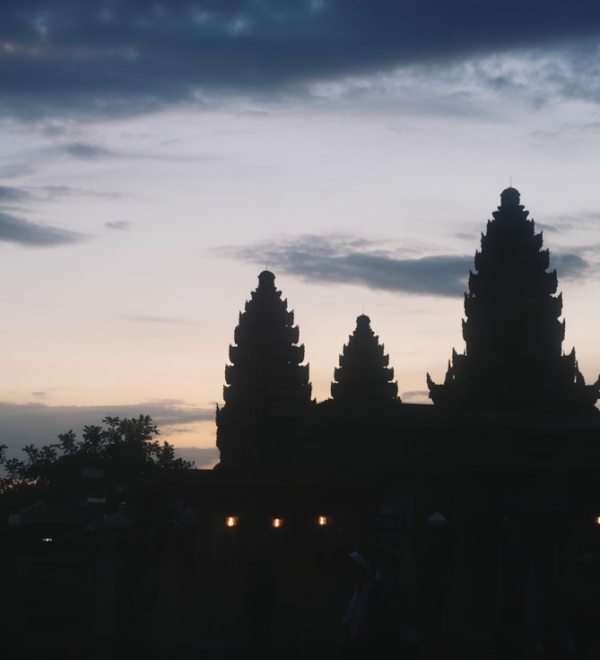
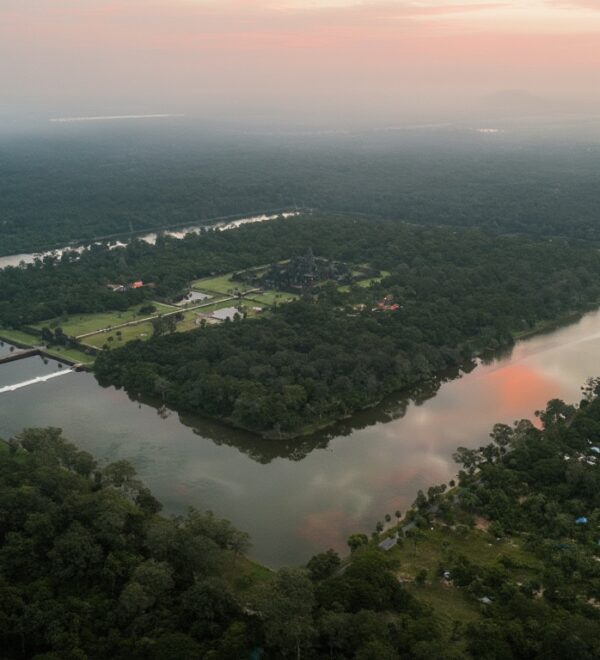
Sunrise at Angkor Wat (included in your pass). The cliché exists because it’s correct. The reflection of Angkor Wat in the moat at first light, before the tour groups arrive from Siem Reap, is one of the significant experiences of Southeast Asian travel. Your tuk-tuk driver will know the drill — $20–25 for the full day starting at 5am. Get there early enough to get position by the reflecting pool. The tourists arrive in waves from about 6:30am; by 8am you can start exploring the temple properly.
The Kampot evening riverfront (cost: a beer). Kampot is where the Cambodia budget equation inverts itself most favourably. Accommodation is cheap ($15–25 for a private room), restaurants along the river serve good food at $4–8 for a main, and the town is genuinely pleasant in a way that Phnom Penh’s tourist zones aren’t. An evening watching the sunset from a riverside terrace with a 50-cent Angkor draft is what budget Cambodia travel is supposed to feel like. Most people don’t give Kampot two nights. Give it three.
A cooking class with market visit ($25–35). Siem Reap has several good options; the ones run by local restaurants rather than standalone tourist operations tend to be better value and more interactive. You spend a morning in the market identifying ingredients, then cook three or four dishes. The class costs about the same as dinner at a mid-range tourist restaurant and leaves you able to make fish amok at home. The market section alone is worth the price.
What Catches Tourists Out
Cambodia’s tourist economy has some predictable money drains that research prevents. Here’s where visitors consistently overspend.
The Siem Reap airport taxi and tuk-tuk scam. The moment you exit arrivals at Siem Reap International Airport, you’ll be approached by drivers quoting $10–15 for a tuk-tuk to town. The correct price is $6–8. The airport has an official tuk-tuk desk inside arrivals — use that, or pre-book through your guesthouse. The same dynamic applies to Phnom Penh Airport: the first ring of taxi touts charges $15–20 for a trip that should cost $7–10 by Grab or official meter taxi. Download the Grab app before you land.
Underestimating transport costs. This is the most consistent gap between budget guides and actual spend. Moving around Cambodia adds up faster than the food savings. Phnom Penh to Siem Reap costs $8–12 by bus. Siem Reap to Sihanoukville has no direct good bus — you often transit through Phnom Penh, making the effective cost $16–22 and 8+ hours. If you’re doing the island route (Phnom Penh → Kampot → Koh Rong → Siem Reap), budget $50–70 just for transport. People who do three or four destinations in a week discover that transport is their biggest daily expense, not accommodation.
Pub Street restaurants in Siem Reap. Fish amok on Pub Street costs $7–9. The same dish in an identical-quality restaurant two streets east: $4–5. The Pub Street premium is roughly 40–60% on every item. Nobody is forcing you to eat there — the street market on the east side of the Old Market sells good local food at local prices, and you’re five minutes’ walk from anywhere in central Siem Reap.
Angkor tuk-tuk negotiation errors. The old $13 tuk-tuk for Angkor is from 2018. Current realistic price: $20–25 for a full day covering the main Angkor circuit. Drivers who agree to $13 will either renegotiate when you’re in the tuk-tuk or cut short the itinerary. Agree a full-day price and specify the temples — small circuit (Angkor Wat, Bayon, Ta Prohm, Baphuon): $20. Large circuit (adding Preah Khan, Neak Pean, Ta Som): $22–25. Write it on paper if there’s a language barrier. Both parties should be clear before you set off.
Not using Grab in cities. Phnom Penh and Siem Reap have Grab (the Southeast Asian equivalent of Uber). Street tuk-tuks in tourist areas charge 2–4x the Grab price for the same trip. The Grab app removes negotiation, shows the fixed price upfront, and the driver knows exactly where you’re going. Download it. Use it for city trips. Save the tuk-tuk negotiation for Angkor, where it’s actually worth the conversation because the day rate is the main variable.
Budget by Trip Length — Worked Examples
Here’s what Cambodia trips actually cost at different lengths, based on realistic spending patterns rather than optimised minimums.
7 days: Phnom Penh + Siem Reap (backpacker)
Phnom Penh 2 nights dorm $18 · Killing Fields + Tuol Sleng $14 · Bus to Siem Reap $10 · Siem Reap 4 nights dorm $36 · Angkor 3-day pass $62 · Tuk-tuk Angkor 2 days $44 · Food 7 days @$10/day local $70 · Misc transport + Grab $15. Excludes flights.
Phnom Penh private room 2 nights $50 · Bus $10 · Siem Reap guesthouse 4 nights $110 · Angkor pass $62 · Tuk-tuk Angkor $44 · Food 7 days @$20/day $140 · Activities (Phare Circus, museums) $30 · Transport/Grab $15.
10 days: Phnom Penh + Siem Reap + Kampot (mid-range)
Phnom Penh 3 nights private room $75 · Bus to Kampot $8 · Kampot 3 nights private room $60 · Bus to Siem Reap $18 · Siem Reap 4 nights private room $100 · Angkor pass + tuk-tuk $106 · Food 10 days @$18/day $180 · Activities $45 · Misc transport $40.
Add Sihanoukville 1 night + Koh Rong Sanloem 3 nights bungalow ($70) + ferries ($48) to the 10-day budget above. The islands lower the daily cost because bungalow food and accommodation are cheap — you’re not moving around spending on transport.
Tipping in Cambodia: What’s Expected and What Isn’t
Tipping is not a cultural expectation in Cambodia the way it is in the US. Cambodians do not tip each other. At the same time, in the tourist economy, tips are appreciated and in some contexts have become expected. Here’s the honest breakdown.
Restaurants: Tipping is not mandatory. Rounding up on a $12 bill to $15 — leaving $3 — is generous and genuinely appreciated at local restaurants. At tourist-facing restaurants, a 10% tip is reasonable if the service was attentive. Many restaurants in Siem Reap have started adding a 5–10% service charge to bills — check before adding more.
Tuk-tuk drivers: Rounding up is fine; tipping beyond the agreed fare is kind but not expected. If a driver has gone out of their way — found an alternative route when the main road flooded, waited an extra hour at Angkor — $2–3 extra is appropriate. For a full day driver who’s been genuinely helpful, $5 is a decent addition.
Guides: For licensed APSARA guides at Angkor, tipping is standard. $5–10 per person for a half-day tour is normal. For full-day tours, $10–20. The licensed guide system pays reasonably but tips represent meaningful supplemental income.
Guesthouses and hotels: Small tips for housekeeping ($1–2/day) are appreciated in mid-range establishments that employ staff. At budget guesthouses where the owner cleans the room themselves, a thank-you on checkout is sufficient. At upmarket hotels, the usual international conventions apply.
Massage: Cambodia has a legitimate massage industry, including training programmes for blind and visually impaired practitioners. A tip of $2–3 on a $10 massage is appropriate. At operations that specifically employ people from disadvantaged backgrounds — common in Siem Reap and Phnom Penh — tipping generously is one of the most direct economic contributions a tourist makes.
What not to do: Don’t tip children selling souvenirs or postcards. This is not a rejection of them — it’s because the economic model of children selling things to tourists keeps them out of school and perpetuates a cycle that costs them more than the tip delivers.
Visas: The Cost Most Budget Guides Don’t Include
The Cambodia tourist visa costs $30 USD on arrival at the airport or land border, or $36 for an e-visa applied for online before travel at evisa.gov.kh. For a two-week trip, this is a fixed cost that doesn’t change by budget tier — it’s the same whether you’re staying in dorms or boutique hotels.
Tourist visa (T-visa): 30 days, $30 on arrival. Extendable once for another 30 days at $45, giving you 60 days total. Apply for extensions at the immigration offices in Phnom Penh, Siem Reap, or Sihanoukville. Your guesthouse can usually point you to a visa agent who handles the paperwork for $50–60 all-in.
E-visa: $36, processed in 3 business days, available at evisa.gov.kh. Accepted at Phnom Penh, Siem Reap, and Sihanoukville airports, and at land crossings including Poipet (Thailand), Bavet (Vietnam), and the main road crossings. Not accepted at every land crossing — check the list before using it for a land entry.
Business visa (E-visa, one year): The long-stay option used by digital nomads and longer-term visitors. $35 entry fee plus $285 for the annual multiple-entry extension. Most people use a local visa agent for this ($300–350 all-in). Allows multiple entries, extendable annually.
Important: Scam visa agencies near the Thai border at Poipet have historically overcharged travellers significantly. The official visa on arrival is $30. Anyone asking for $50–60 “plus fees” at a border desk that looks official is running the standard scam. Pay at the counter marked “Immigration” only.
Digital Nomad Budget — One Month in Cambodia
Cambodia is a legitimate digital nomad base, particularly Phnom Penh. The infrastructure is better than people expect, visa access is flexible, and costs for longer stays drop significantly from tourist rates.
Accommodation: A furnished one-bedroom apartment in BKK1 (the central Phnom Penh expat neighbourhood) rents for $400–700/month. Serviced apartments with a pool run $600–900. In Siem Reap, a clean furnished flat costs $300–500/month. These are significant discounts over nightly rates — the economics of staying a month in Cambodia are substantially better than staying a week.
Visa: Cambodia offers a 12-month E-visa (business visa) that allows multiple entries and is renewable inside the country, costing $35 on entry plus $285 for the 12-month extension. Many long-term residents use a local visa agent for the extension ($300–350 all-in) for convenience. Tourist visas are 30 days on arrival ($30) with a 30-day extension available ($45). For a stay of 3+ months, the business visa is the practical choice.
Food: Cooking from a local market in Phnom Penh (morning wet markets near BKK1): $150–200/month for good ingredients. Mix of cooking and eating out at local restaurants: $250–350/month. Eating out predominantly at local Khmer restaurants, avoiding tourist spots: $350–450/month. You can eat very well in Phnom Penh for less than $400/month if you’re eating local food.
Coworking: Factory Phnom Penh, The Factory by Emerald Hub, and FACTORY Phnom Penh (different places, confusingly) charge $100–180/month for a hot desk. In Siem Reap, options are more limited: Geeks in Cambodia and a few café-coworking hybrids run $80–120/month. Good internet is widely available.
Total monthly estimate:
Apartment $500 · Food (mix local) $300 · Coworking $130 · Transport (Grab mostly) $60 · SIM/data $15 · Sundry $100. One of the most affordable capital cities in Southeast Asia for a comfortable nomad lifestyle. Bangkok is 2–3x the cost for equivalent accommodation quality.
Apartment $380 · Food $250 · Coworking $100 · Transport $40 · SIM $15 · Sundry $80. Cheaper than Phnom Penh and quieter — Siem Reap’s expat scene is smaller but it exists. The proximity to Angkor means you never run out of places to go on weekends.
- How much does Cambodia cost per day in 2026?
- Backpacker tight: $25–35/day (dorm, local food, minimal transport). Realistic backpacker: $35–50/day once you factor in occasional transport and a mix of food choices. Mid-range independent: $55–85/day (private rooms, mix of local and restaurant meals, organised transport). The Angkor pass ($37–62) is a significant one-off cost — factor it in separately rather than averaging it into a daily figure.
- Is Cambodia cheap for tourists?
- Yes — one of the cheaper countries in Southeast Asia. Street food costs $1–3. A clean private room in Siem Reap runs $15–25/night. Beer on happy hour: $0.50. The genuine bargain is local food, which is both cheap and very good. Where Cambodia gets more expensive relative to expectations: transport between cities adds up, Angkor is a $37–62 fixed cost, and Western food at tourist restaurants is only marginally cheaper than Bangkok.
- How much cash should I bring to Cambodia?
- USD cash is the practical currency for Cambodia. Bring $200–300 as emergency cash, then withdraw from ATMs as needed. ATM fees run $3–5 per withdrawal — withdraw larger amounts ($150–200) less frequently to minimise this. ABA Bank and ACLEDA Bank have lower fees than the tourist-area Canadia machines. Cards work at hotels and tourist-level restaurants but not at markets, tuk-tuks, or street food stalls.
- How much is a tuk-tuk in Cambodia per day?
- For a full Angkor temple day: $20–25. Negotiate the price and agree on which temples before you get in. For city trips in Phnom Penh or Siem Reap: $2–5 depending on distance. The Grab app operates in both cities and gives transparent fixed pricing without negotiation — useful if you don’t want to bargain or aren’t sure of the going rate.
- How much is the Angkor Wat entrance fee?
- 1-day pass: $37. 3-day pass: $62 (usable over any 3 days within a 7-day window). 7-day pass: $72. Buy at the official ticket booth on the main road approaching the complex — not from touts in Siem Reap. The 3-day pass is worth it for most visitors: it allows the main circuit on day one and outlying temples (including Banteay Srei) on day two without rushing.
- What is the cheapest way to get around Cambodia?
- For long distances, the express bus network is the cheapest reliable option: Phnom Penh to Siem Reap costs $8–12 (Giant Ibis or Mekong Express, 6 hours). Within cities, tuk-tuks and Grab are the practical options. Renting a motorbike is possible in some cities if you’re experienced — $5–10/day — but Cambodia’s roads and traffic require genuine riding experience, not just “I rode a scooter in Bali once.”